Beyond What We’re Taught There is something unsettling about realising how much of a person’s worldview is inherited before they are old enough to examine it for themselves. Not just politics or religion, but fear. Suspicion. Silence. The subtle messages about who belongs and who does not. Which lives are grieved publicly and which disappear …
Beyond What We’re Taught
There is something unsettling about realising how much of a person’s worldview is inherited before they are old enough to examine it for themselves.
Not just politics or religion, but fear. Suspicion. Silence. The subtle messages about who belongs and who does not. Which lives are grieved publicly and which disappear quietly into statistics and headlines. Most of it arrives long before language for it does. Children absorb it at dinner tables, in passing comments, in stories told with bitterness still attached to them. Sometimes they inherit trauma without ever knowing where it began.
And then occasionally, life places two people beside each other who were never supposed to meet as human beings.
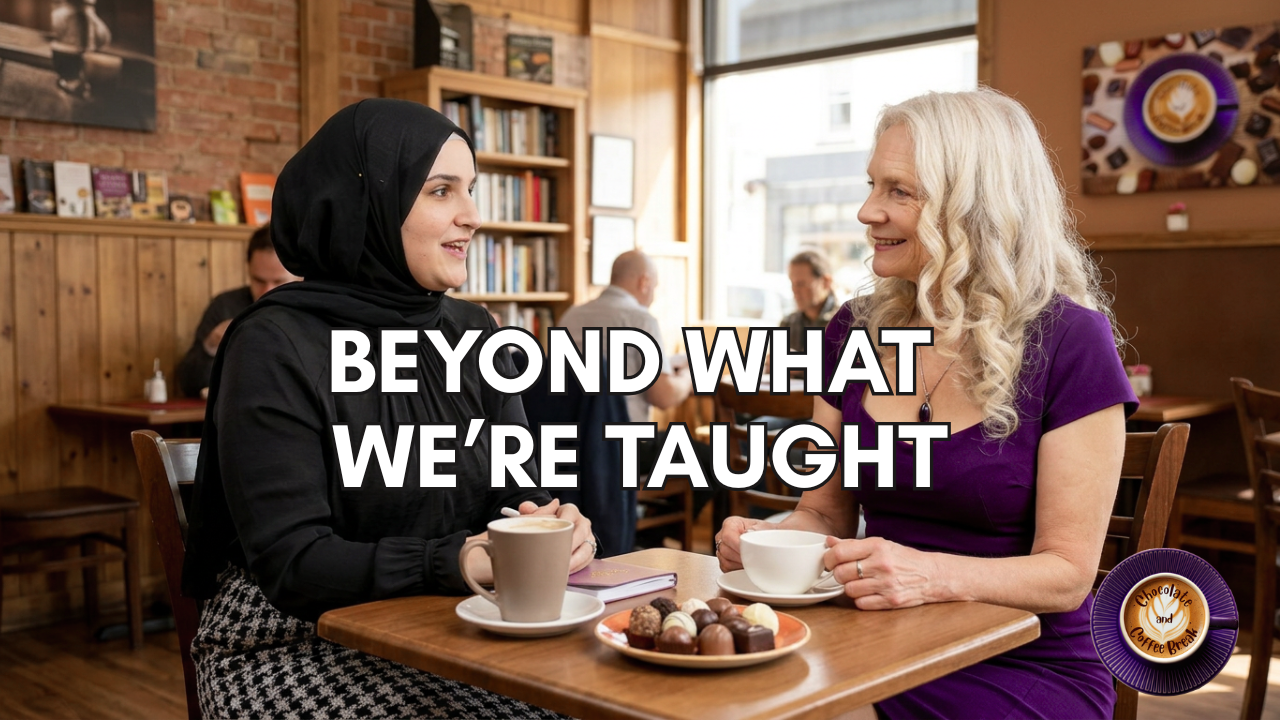
That tension sits at the centre of my conversation with Miriam El Houli on Chocolate and Coffee Break. Not as a political argument, but as a human one.
Mariam spoke about surviving war in Lebanon as a teenager with a baby in her arms. She described the moment she understood that safety is not distributed equally, and that the colour of a passport can determine who is considered worthy of rescue. There is no way to hear something like that and keep conflict safely abstract. It pulls war out of newspapers and into the body of a seventeen-year-old mother trying to survive.
But the conversation never stayed there.
What interested me more was the quieter question beneath it all: what happens to people when fear becomes inheritance?
Hatred Rarely Begins With Children
The friendship at the centre of Mariam’s novel The Olive Tree exists inside a world already divided long before the girls themselves understand why. Two teenagers from different backgrounds form a connection that the adults around them struggle to accept. Not because the girls have harmed one another, but because generations of grief, politics, violence, and identity have already shaped the emotional landscape they are growing up inside.
The uncomfortable truth is that most prejudice does not arrive announcing itself as hatred. Often it arrives disguised as protection. Loyalty. Tradition. Survival.
People pass down stories because they are trying to make sense of their pain. Sometimes they pass down fear because fear once kept them alive.
That complexity matters.
Simplifying people into heroes and villains has become one of the easiest ways to avoid looking honestly at human behaviour. Yet the conversation with Mariam kept returning to the reality that most people are carrying histories nobody else can see. Trauma that did not begin with them. Fear they did not consciously choose. Beliefs absorbed so early they feel indistinguishable from truth.
And still, inside all of that, people continue trying to love each other.
The Space Between Certainty and Compassion
There was a moment in the conversation where Mariam spoke about the two girls in her story simply wanting the same things as any other teenagers. Friendship. Safety. A future. The freedom to grow up without carrying the weight of adult conflict on their backs.
It sounds obvious when spoken aloud. Almost painfully obvious.
Yet so much division depends on forgetting this basic human reality. Once people become symbols instead of neighbours, it becomes easier to justify cruelty toward them. Easier to flatten entire communities into a single narrative. Easier to stop asking questions.
Compassion becomes much harder when certainty takes over.
That does not mean ignoring injustice or pretending suffering is equal in every situation. The conversation never attempted to erase the realities of war, violence, or prejudice. But it did ask something more difficult of us: to resist reducing human beings to the worst thing we have been taught about them.
There is tension in that space.
Sometimes compassion feels threatening because it disrupts the simplicity of being certain. It asks people to sit with contradiction instead of immediate judgment. To acknowledge pain without allowing pain to become permission for dehumanisation.
That is uncomfortable work.
It is also deeply human work.
Some Beliefs Feel Like Family Heirlooms
Toward the end of the episode, Mariam spoke about intergenerational trauma and how deeply it shapes behaviour, addiction, fear, relationships, and identity. Not always loudly. Often quietly. Through patterns people repeat without fully understanding why.
The truth is that many of us are carrying emotional inheritances we never consciously agreed to.
Ideas about who is trustworthy. Who is dangerous. What success looks like. Which emotions are acceptable. Which people deserve empathy. Which stories matter.
Some of these beliefs are so embedded inside families and cultures that questioning them can feel almost disloyal.
But if nobody pauses long enough to examine what they have inherited, cycles continue untouched.
Brew the Change
The Brew the Change challenge from this episode asks something deceptively simple:
Take a moment of stillness. Pour yourself a cuppa and some chocolate and reflect on this:
What is a belief, fear, or bias you carry — and where did it come from?
Is it truly yours? Or was it passed down through family, culture, history, or pain?
There is something confronting about realising that not every thought inside us originated there. Some beliefs arrived through repetition rather than reflection. Some fears belonged to people who came before us. Some judgments formed before we had enough life experience to challenge them.
That does not make people bad. It makes people human.
But recognising inherited thinking creates the possibility of choosing differently.
Not perfectly. Not instantly. Just consciously.
And perhaps that is where bridge-building actually begins. Not in grand declarations about unity, but in smaller moments where somebody becomes willing to question the stories they have always accepted as fixed.
What might change if more of us became curious about the fears we inherited instead of defending them automatically?
There is no neat ending to conversations like this.
War does not disappear because people choose compassion. Trauma does not dissolve because somebody reads a novel or shares a coffee with a neighbour. Human beings remain complicated, contradictory, and shaped by histories they did not choose.
But somewhere between certainty and curiosity, something softer can still exist.
A conversation.
A pause before judgment.
A willingness to see another person fully.
Sometimes that is not small at all.
Get in Touch with Us
We’d love to hear from you—share your thoughts or ask a question!