What happens when your life changes overnight—when the person you were yesterday can’t show up the same way today?
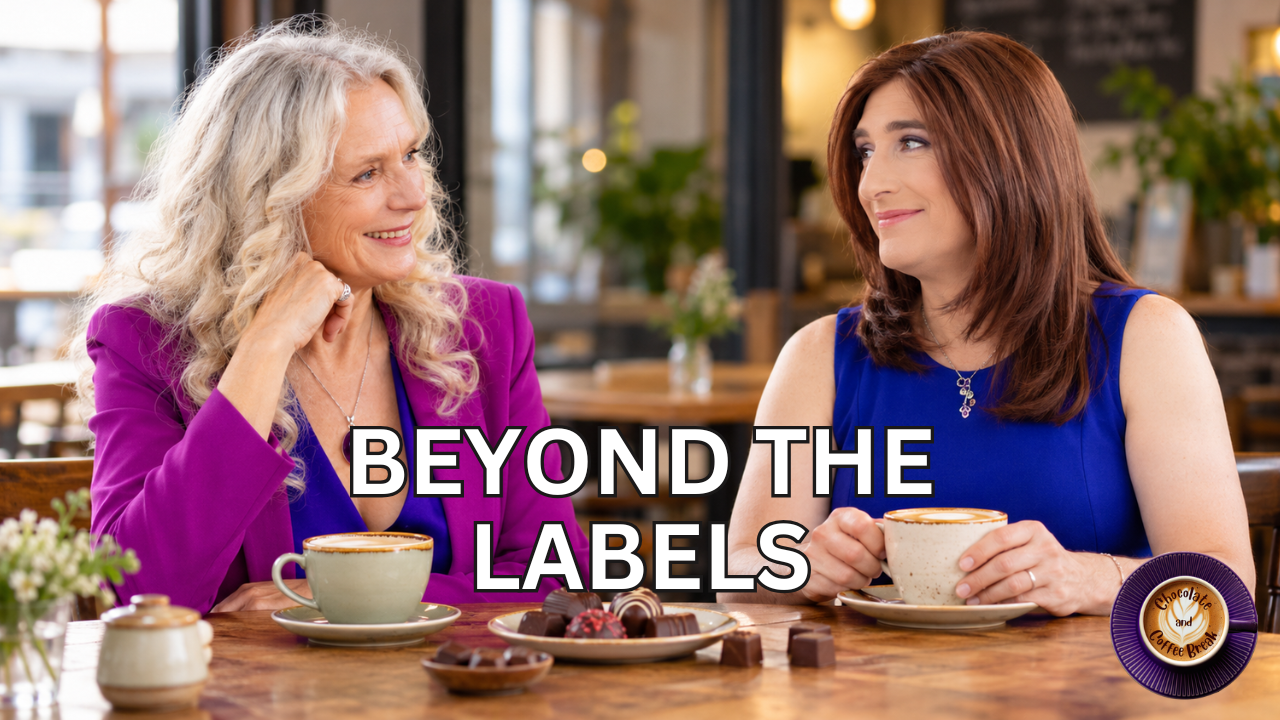
In Episode 14 of Chocolate & Coffee Break, Andrea Putting sits down with Leigh-Anne Sharland , who knows this experience intimately.
Leanne spent decades building a 40-year corporate career, including 30 years at the leading edge of data-driven decision-making. She was the person helping others make major choices fast.
Then suddenly—she wasn’t.
“I carry unpredictability—moment to moment.”
Andrea opens with a heart question: What’s something you carry that no one sees?
Leigh-Anne’s answer defines the reality of invisible illness: unpredictability. Her ability to speak, think, or move can shift moment to moment—often without warning.
Unless you know her well, you might not see it at all.
From high-performing to shut down
Leigh-Anne describes the fear of losing cognitive function. One day she was helping traders make major decisions; the next day she couldn’t think for herself.
And when your identity is built around competence, speed, and productivity, illness doesn’t just affect the body—it hits your sense of self.
The self-worth crash
At first, Leigh-Anne says brain fog protected her from fully understanding what was happening.
But when she attempted to return to work and couldn’t, the emotional impact landed hard: failure, lost purpose, and the question many people quietly fear—
“Will I ever matter again?”
The shift came ten years before her expected retirement. There were no plans, no pivot strategy, and no “next chapter” prepared.
Dysautonomia: an invisible condition with visible consequences
Leigh-Anne explains dysautonomia, a disorder of the autonomic nervous system—impacting organs, heart, brain, and mobility.
She keeps multiple mobility aids available because her symptoms aren’t constant. They fluctuate.
And that unpredictability is exactly why invisible disability can be so hard to navigate in a world built for consistency.
The shame of needing a walking aid at 57
When Leigh-Anne first needed a walking stick, she felt ashamed.
Not because the stick was wrong—because society had taught her mobility aids were “for old people.”
So she fought it.
That’s one of the quiet truths this episode exposes: many people resist aids not because they don’t need them, but because of stigma, embarrassment, and the fear of being judged.
“Noise and crowds can shut me down.”
One of the most powerful moments in the episode comes when Leanne describes sensory overload:
As soon as there’s external stimulation—noise, crowds, anything that hits her nervous system—something can shut down.
Sometimes it’s thinking. Sometimes it’s walking.
So she initially withdrew from the world to stay safe.
But she knew that wasn’t her. A life inside wasn’t the life she wanted.
So she re-entered slowly—gradually learning to move in public again, even when her brain slowed down or her body didn’t cooperate.
The invisible barriers people don’t notice
Leigh-Anne brings attention to everyday environments most of us never question:
- Shops where you’re pressured to make quick decisions
- Crowds moving fast without noticing your pace
- People skirting around you, increasing fall risk
- Escalators that can be dangerous when balance is compromised
- Phones pulling attention away from shared public safety
The world often treats slow as inconvenience.
But for someone with disability, rushing past them isn’t just rude—it can cause distress, panic, or even injury.
Ableism isn’t always intentional—but it’s real
Leigh-Anne and Andrea explore ableism as a set of assumptions: that everyone’s body and brain function the same, and that anyone who doesn’t “keep up” is a problem.
They also highlight that disability has multiple definitions:
- dictionary language
- medical systems
- government/economic eligibility
…and those definitions don’t always match real lived experience.
This matters for people with chronic fatigue, fibromyalgia, and many “silent” women’s health issues—conditions that people push through while still struggling daily.
The Hidden Disabilities lanyard
Leigh-Anne explains the Hidden Disabilities lanyard as a signal that someone may need extra time, understanding, or assistance—even if their disability isn’t visible.
It helps bridge the gap between what a person is experiencing and what others can see.
Because people can’t be compassionate about what they don’t understand.
Asking for support instead of pushing through
Leigh-Anne shares a deeply human truth: she didn’t learn advocacy perfectly.
At first, she got angry—especially when she felt unsupported or unseen.
But she realized anger was costing her joy and spoiling her experiences.
Over time, she learned to explain her needs calmly before reaching a breaking point—turning frustration into communication, and communication into inclusion.
Inclusive design begins with including disabled people
One of Leigh-Anne’s strongest messages is simple:
Include disabled people in decision-making.
Ramps, accessible entrances, quiet spaces, better flow in public buildings—these shouldn’t be afterthoughts.
And accessibility isn’t just for wheelchair users. It impacts neurodiverse people, people with chronic illness, sensory sensitivity, injuries, and aging bodies.
Disability isn’t rare. It’s human.
“Suddenly Different”: purpose after the pivot
Leigh-Anne didn’t return to the same career—but she found a new purpose.
She created the “Suddenly Different” podcast, sharing stories of life-changing moments—illness, relationship shifts, extreme experiences—and showing that change can still be meaningful, even when it doesn’t fit the original plan.
Her message isn’t toxic positivity.
It’s reality plus hope:
Change can be used for good—even for great.
This week’s challenge
Slow down.
Notice who needs space.
And practice matching someone else’s pace for one day—then reflect on what it changes in you.
Because difference isn’t the problem.
It’s the pathway to empathy.
And as always: let love be the loudest voice.