The Quiet Moment We Pull Away There is a moment that happens so quickly most of us barely notice it. A conversation shifts. Someone says something unfamiliar. A perspective unsettles us. We feel awkward, uncertain, exposed, or defensive. And somewhere inside ourselves, we begin to pull back. Not dramatically. Quietly. We change the subject. We …
The Quiet Moment We Pull Away
There is a moment that happens so quickly most of us barely notice it.
A conversation shifts. Someone says something unfamiliar. A perspective unsettles us. We feel awkward, uncertain, exposed, or defensive. And somewhere inside ourselves, we begin to pull back.
Not dramatically. Quietly.
We change the subject. We disengage. We stop listening as openly as we were moments before.
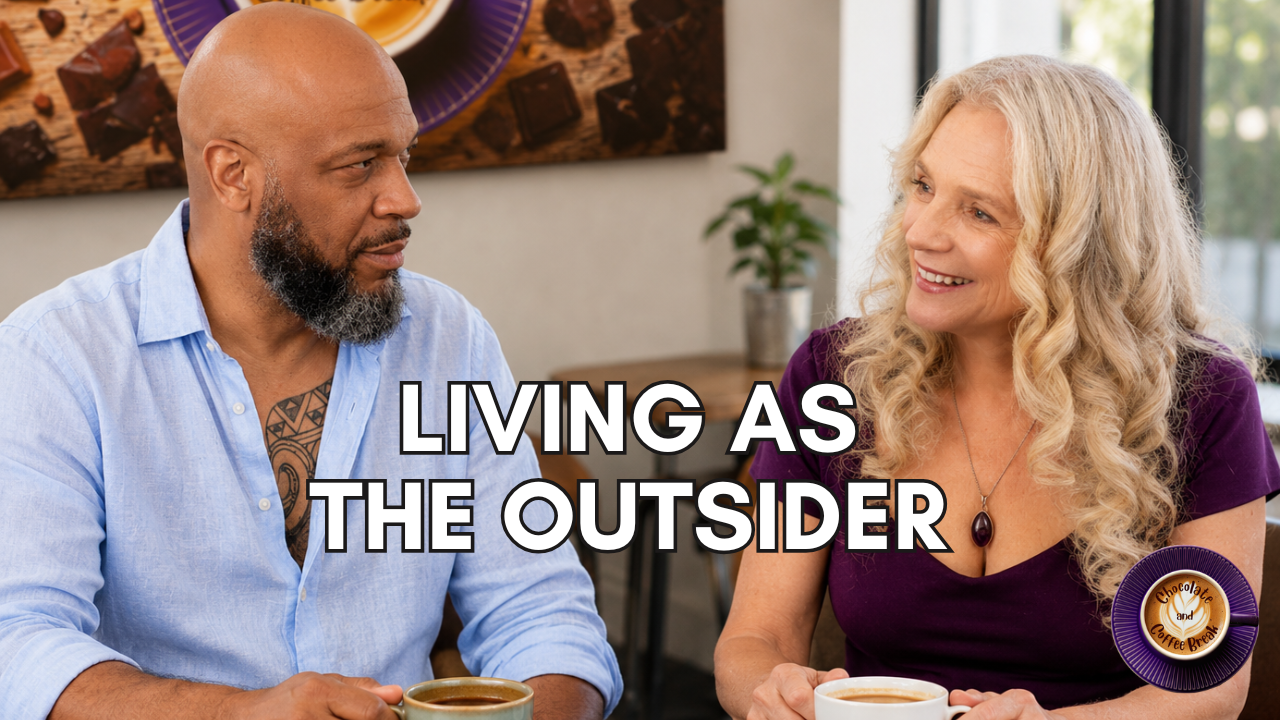
In my conversation with Stone Gye on Chocolate and Coffee Break, we explored racism, belonging, and what it means to move through life as the outsider. But beneath those themes sat something even more human: the instinct people have to retreat from what feels unfamiliar.
Stone spoke about living much of his life aware of being different. As an African-American man who grew up in Japan, served in the military, migrated to Australia, and later moved to France, he described moving through spaces where belonging was never assumed.
At one point he said simply, “I’ve always been an outsider.”
There was something deeply confronting in the simplicity of that sentence.
Not because being an outsider is rare, but because so many people quietly carry some version of that feeling. Sometimes because of race. Sometimes because of disability, grief, class, culture, trauma, sexuality, illness, or simply being different in ways others struggle to understand.
Many people know what it feels like to stand near the edge of belonging and wonder whether there is really space for them.
Years ago, Stone shared experiences of racism with me that stayed long after the conversation ended. It was one of the conversations that helped shape my understanding that just because something is not my lived experience does not mean it is not my responsibility to care.
Not to centre myself in someone else’s story.
Not to pretend I fully understand.
But to remain willing to listen.
The Cost of Staying Separate
One of the tensions in this conversation was that Stone was not only talking about individual prejudice. He was talking about systems, assumptions, and patterns that shape how people are treated long before they speak.
He shared experiences of repeatedly being stopped and searched while serving in the military in the United States. Later, he described struggling to be heard within the medical system in Australia and eventually travelling overseas to receive care where he felt respected and seen.
These stories were not told dramatically. In some ways, that made them harder to hear.
There is something difficult about hearing painful experiences described calmly, almost matter-of-factly, because it reveals how normal those experiences have become.
Stone also said something that carried weight far beyond the conversation itself:
“Racism was made up, and it prevents us from being what we are.”
That sentence reaches beyond politics. It reaches into the human cost of separation itself.
Anything built to divide people eventually diminishes people. Anything that teaches us to fear difference weakens trust, empathy, creativity, and connection. Entire communities lose something when people are not fully seen, heard, welcomed, or allowed to contribute.
The deeper ache underneath this conversation was not only exclusion. It was disconnection.
And perhaps that is why conversations like this matter.
Not because they solve everything neatly.
Not because listening instantly changes systems.
But because understanding rarely begins in silence.
What Fear Does to Connection
I think many people genuinely want to be compassionate. But compassion becomes harder when discomfort enters the room.
Discomfort can look like uncertainty. Fear of saying the wrong thing. Defensiveness. Shame. Not knowing enough. Not knowing how to respond.
And often, without even realising it, people begin to withdraw.
That withdrawal may not look cruel. It may simply look like silence. Distance. Avoidance. Closing down emotionally before understanding has had the chance to grow.
One of the things I valued about this conversation was that it did not demand perfection. It invited presence.
There is a difference.
Presence says:
Stay. Listen. Learn.
Not because you have mastered the conversation, but because human dignity matters enough to remain engaged.
That feels important right now.
Many people are becoming quicker to label and slower to listen. Genuine curiosity can feel increasingly rare. Deep listening rarer still.
Yet meaningful connection has never depended on perfection. It has always depended on willingness.
Brew the Change
This week, when a conversation feels unfamiliar or uncomfortable, pause before you pull away.
Take a breath.
Stay curious.
Remain present a little longer.
You do not have to have all the answers to offer someone dignity.
Sometimes understanding begins the moment we choose not to retreat.
I think this matters because division is rarely created in one dramatic moment. More often, it is created quietly through repeated acts of distancing.
A look away.
An assumption.
A withdrawal from discomfort.
A refusal to stay in the conversation long enough to understand.
But perhaps connection is built the same way.
Quietly. Repeatedly. One moment of presence at a time.
There are no neat endings to conversations like this.
Human beings are complex. Systems are complex. Healing is complex.
But I still believe conversations matter.
I believe listening changes us.
I believe dignity matters.
And I believe communities become stronger when people are willing to stay at the table long enough to truly see one another.
Let love be the loudest voice.
Get in Touch with Us
We’d love to hear from you—share your thoughts or ask a question!