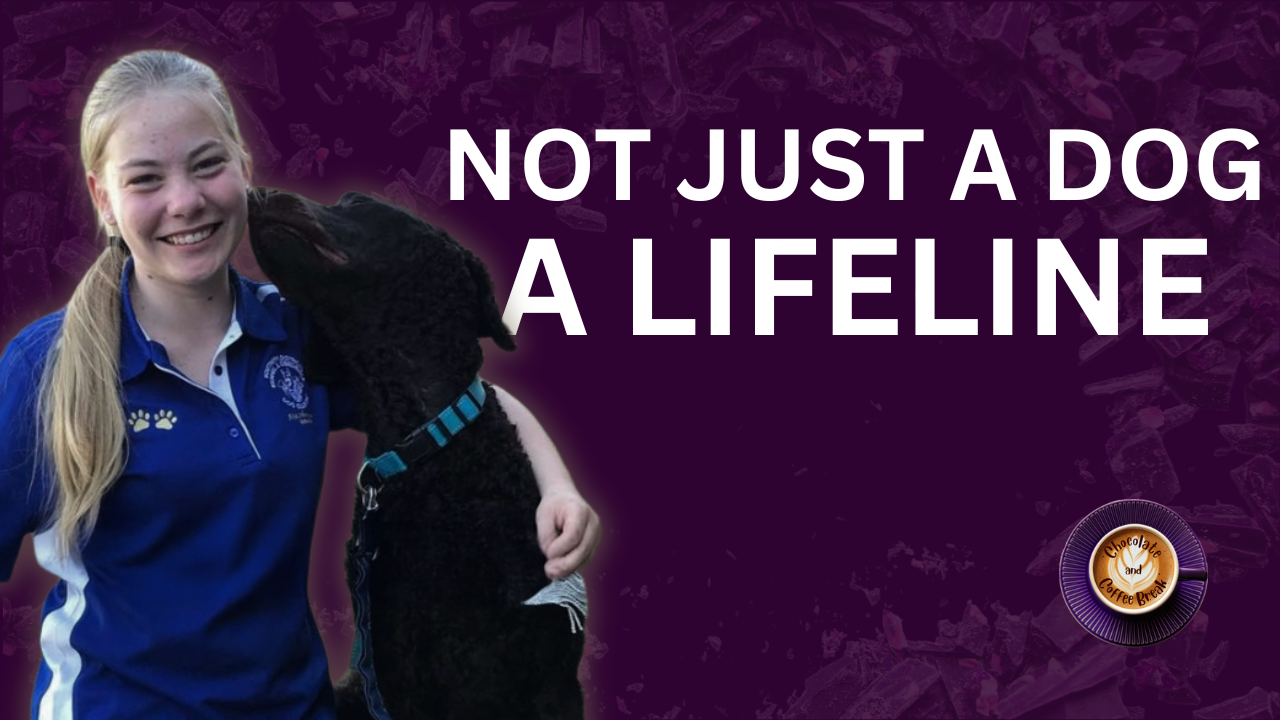
The Quiet Exhaustion of Being Misunderstood
There is a particular kind of loneliness that comes from needing the world to understand something you cannot constantly explain.
Not dramatic loneliness. Not cinematic loneliness. The quieter kind. The exhaustion of moving through ordinary spaces while carrying realities other people cannot see. The strain of knowing your safety may depend on people respecting boundaries they do not understand.
Most people look at an assistance dog and see the dog first. The harness. The training. The novelty. Sometimes even the entertainment value. They see something unusual entering an ordinary public space and instinctively turn toward it with curiosity.
What often goes unseen is the person beside the dog, calculating risk in the background of everyday life.
That tension sat quietly underneath my conversation with Monika Gawen. On the surface, we were talking about assistance dogs, diabetes, autism, and public behaviour. Underneath it sat something much deeper: what it means to move through the world when your wellbeing depends on forms of trust most people never have to think about.
Some People Have to Earn Their Freedom Differently
One of the things that struck me about Monika’s story was how practical it was.
There was no performance in the way she spoke about her life. No attempt to turn herself into inspiration. She talked about training dogs the same way someone might talk about learning to drive a car or navigating a difficult workplace. Necessary. Relentless. Daily.
At fourteen years old, she began owner-training a diabetic alert dog because a fully trained assistance dog costing upwards of twenty thousand dollars simply was not realistic for her family. There was no dramatic turning point where life suddenly became meaningful. There was just persistence. Research. Trial and error. Repetition. Fear. Hope. More repetition.
And then there was Ronnie breaking through a door to alert her mother when Monika’s blood sugars had dropped dangerously low.
Even that story was told matter-of-factly.
Perhaps that is part of what gave the episode its weight.
So many conversations around disability become emotionally packaged for public consumption. People are often expected to either soften their experience for comfort or heighten it for inspiration. Monika did neither. She spoke plainly about dependence, danger, public misunderstanding, and the freedom her dogs gave her to live more independently.
That honesty carried its own emotional gravity.
The Difference Between Curiosity and Entitlement
There is a particular contradiction disabled people often encounter in public life: visibility can create both support and intrusion at the same time.
Monika described people photographing her dog in airports. Children being sent over to distract working dogs while parents shopped. Businesses refusing access because the dog was not a Labrador or a traditional guide dog breed. At one point, an assistance dog was even attacked by another dog inside a shop because pet access rules were not being enforced properly.
None of these moments came from outright cruelty. Most came from assumption. From unfamiliarity. From people treating assistance dogs as public objects rather than medical support.
The conversation kept returning to one simple request:
ignore the dog.
Not because the dog is unfriendly. Not because people are wrong for finding them beautiful or interesting. But because the dog is working. Because distraction carries consequences. Because curiosity does not automatically entitle us to access.
There was something confronting in Monika’s comparison:
“Would you go and take photos of a wheelchair?”
The question lingers because most people would immediately recognise the boundary in one situation while missing it entirely in another.
And perhaps that says something uncomfortable about the way society responds to visible support systems. We are often more comfortable admiring assistance than understanding dependence.
Not All Support Looks the Same
Another important layer in this conversation sat around legitimacy.
People have learned to recognise certain versions of disability more easily than others. A Labrador in a harness. A white cane. A wheelchair. Familiar signals help people feel certain about what they are seeing.
But uncertainty often creates suspicion.
Monika spoke about people questioning her dog because he did not fit their expectation of what an assistance dog “should” look like. Yet the reality is far more complex. Assistance dogs can support seizures, cardiac events, autism, anxiety, mobility issues, diabetic episodes, and countless other conditions in highly individualised ways.
There was something deeply human in that tension.
So much of social belonging depends on whether other people perceive your needs as legitimate. Whether your difference looks recognisable enough to receive compassion without interrogation.
People whose realities sit outside familiar categories are often forced into exhausting negotiations with public perception. Explaining themselves. Proving themselves. Defending accommodations they should not have to justify.
The emotional labour of that rarely gets acknowledged.
Brew the Change
The deeper truth beneath this episode is not really about dogs.
It is about the fragile space between assumption and understanding. The split second where we decide whether another person’s behaviour is strange, inconvenient, suspicious, attention-seeking — or whether there may be something we do not yet understand.
This week’s Brew the Change challenge is simple:
pause before you assume.
We often walk past quiet heroes every day. The person moving slowly through the checkout line. The friend cancelling plans because they are running on empty. The colleague who grows quiet instead of speaking up.
Take a breath. Offer patience. Give space.
Not every act of compassion needs to be loud enough to be noticed.
Sometimes the most human thing we can do is allow another person to move through the world without demanding they justify themselves first.
What might change if we became less interested in categorising people — and more willing to let them be human in peace?
There is no perfect way to build a compassionate society. People will still misunderstand each other. Public spaces will still carry friction. Curiosity will still occasionally overstep into intrusion.
But conversations like this matter because they slow us down long enough to notice where humanity gets lost in ordinary moments.
Not in grand moral failures.
In airports.
In shopping centres.
In the instinct to stare.
In the urge to reach out before asking.
In the assumption that what we do not understand must somehow be available for public access.
And perhaps compassion begins there — in learning that not every story owes us an explanation before it deserves dignity.