Most of us have opinions about things we have never had to live. We form views from a distance. We read articles, watch the news, listen to conversations, and quietly decide where we stand. Sometimes those opinions are thoughtful. Sometimes they are inherited. Often they are built on far less experience than we realise. Then …
Most of us have opinions about things we have never had to live.
We form views from a distance. We read articles, watch the news, listen to conversations, and quietly decide where we stand. Sometimes those opinions are thoughtful. Sometimes they are inherited. Often they are built on far less experience than we realise.
Then life introduces us to a person. Not an issue, a headline, or a debate, but a real human being. Suddenly the distance disappears.
When Distance Disappears
During my conversation with Jo Connolly, she spoke about meeting her husband Michael and being drawn to him simply because he was Michael. She wasn’t looking for a cause to support or a social issue to understand. She met someone she cared about and built a life with him.
What followed was not a lesson in culture or politics. It was something much more personal.
Through her relationship, Jo found herself seeing parts of Australia she had never really seen before. Not because those realities had been hidden, but because they had never touched her life closely enough to demand her attention.
There is a profound difference between hearing that prejudice exists and watching somebody you love experience it. There is a difference between knowing something intellectually and seeing the impact up close. The issue itself has not changed. What changes is your proximity to it.
This happens more often than we realise.
Not only with race or culture, but with almost everything. We carry assumptions about people we have never spent much time with. We form opinions about generations, religions, neighbourhoods, professions, political views and communities. Most of us do not set out to be unfair. We simply inherit stories about the world and rarely have a reason to question them.
The Stories We Inherit
Then somebody enters our life and complicates the story.
A neighbour becomes a friend. A colleague shares something of their experience. A family member marries someone from a different culture. A grandchild grows up seeing the world differently from us.
Suddenly the neat categories no longer feel quite so neat.
Jo’s story is often described as one of walking between cultures, but underneath that is something many of us recognise. It is the experience of having certainty replaced by curiosity.
That is not always comfortable.
Simple explanations ask very little of us. Complexity asks much more. It asks us to hold more than one truth at a time. It asks us to acknowledge both beauty and pain, progress and disappointment, pride and hurt. Most of all, it asks us to accept that our understanding may be incomplete.
That tension surfaced several times throughout our conversation. Jo spoke about assumptions people make about her family. She spoke about the pressure some Aboriginal people feel to explain or defend their identity. She spoke about the frustration of seeing conversations driven by fear rather than understanding.
Although the subject matter was specific, the pattern felt familiar.
Again and again, we divide the world into people we understand and people we do not. We decide who belongs in which group and then build stories around those decisions.
Human beings are wonderfully inconvenient in that way. Just when we think we have somebody figured out, they show us a part of themselves that does not fit the story we were telling.
Belonging Is Rarely One Thing
Jo and Michael’s children know their Aboriginal heritage and they know their Irish heritage. Neither cancels out the other. Neither diminishes the other. Yet people still ask them which side they identify with, as though identity must always be reduced to a single answer.
Perhaps belonging has never been that simple.
Many people live between worlds in one way or another. Some move between cultures. Some move between generations. Some navigate different communities, different beliefs, or different parts of themselves depending on where they are and who they are with.
The details may be different, but the experience is remarkably common.
Much of life is spent trying to work out how to belong without abandoning parts of who we are.
Conversations like this matter because they make it harder to hold onto easy assumptions. Once you have sat with somebody’s story, the neat version of the world rarely feels quite as convincing.
Brew the Change
Jo’s challenge was simple.
Have a look at another culture and maybe walk in somebody else’s shoes for a little while.
At first glance, that can sound like a pleasant idea. The sort of thing most of us would agree with before moving on with our day.
But there is something more challenging hidden inside it.
Walking in somebody else’s shoes begins with accepting that we do not already know what it is like to wear them.
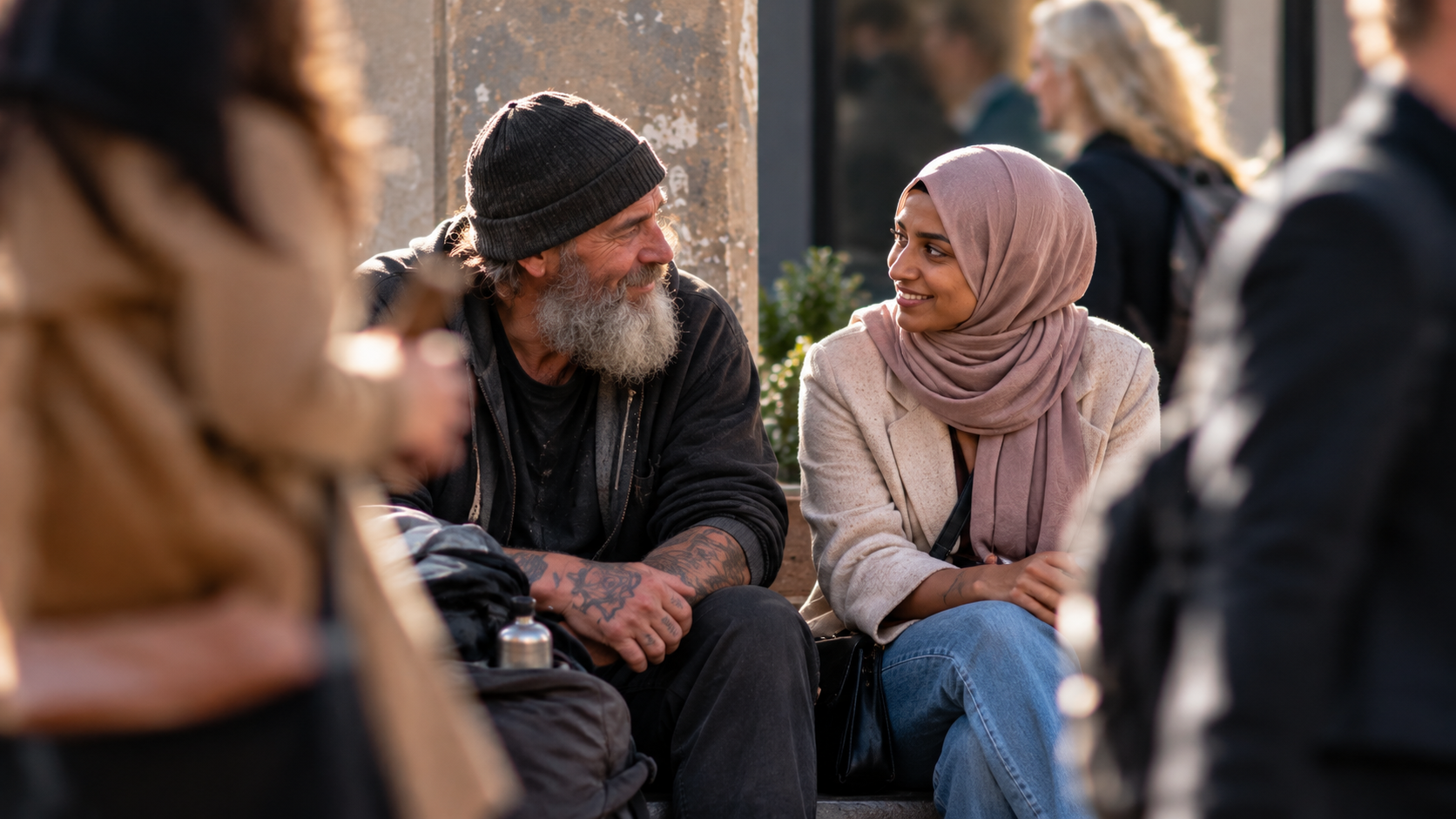
It asks us to move beyond observation and towards relationship. Beyond assumptions and towards curiosity. Beyond speaking and towards listening.
That does not require international travel or a university degree. More often than not, it begins much closer to home. It starts with a conversation, a question, or a willingness to hear a story that is different from our own.
Understanding rarely arrives all at once. It usually arrives slowly, through relationships, shared experiences, and conversations that allow us to see beyond our first assumptions.
There Is Always More To The Story
Most of us will never experience the world exactly as another person does.
We won’t grow up in their family. We won’t carry their memories. We won’t know what it felt like to be them at ten years old, or twenty, or fifty. We won’t live with the assumptions people make about them, and we won’t see the world through the same set of experiences.
Perhaps that is why understanding can be so difficult.
We are often trying to make sense of people while only seeing a small part of the picture. Sometimes we fill the gaps with assumptions. Sometimes we rely on stories we have inherited. Sometimes we convince ourselves we understand far more than we do.
Jo’s family challenges that instinct. Not because their story is unusual, but because it reveals how quickly our neat categories begin to fall apart when real people enter the picture.
A woman can be proud of her Irish ancestry and proud of the family she has built with an Aboriginal man. Children can know and honour more than one heritage. People can belong in more than one world at the same time.
Life is rarely as tidy as the boxes we create for it.
The conversation leaves me with a question rather than an answer.
How many of the things we think we know about other people would change if we knew their story?
I suspect more than we realise.
Watch the episode on YouTube
Get in Touch with Us
We’d love to hear from you—share your thoughts or ask a question!